Showing posts with label American University. Show all posts

Thursday, November 13, 2008

Social Media Hits DC with Insight

As I mentioned in my previous post, I went to the Social Media Club - DC event at the National Press Building on social searches versus Google searches (not how they phrased it but it addresses the point). The speakers were Chris Seline (@dumbfounder), Laurence Hooper (@lhooper), Jared Goralnick (@technotheory), Greg Gershman (@greggersh) and Aaron Brazell (@technosailor). The reason I have names in parenthesis are because these are all their twitter names. I'll explain that more in a bit.

They started off discussing the difference between social searches and Google searches. There were many conflicting views amongst the board but here is what I got. Google searches will get what you want but it cost time. Social searches are more customized and personalized to the user. Aaron Brazell gives the example of Thomas Hawk whose goal in life is to publish 1,000,000 photos on flickr. He has already posted about 20,000. If Aaron wanted to find a photo that Thomas took of New York a couple years ago then it would take him awhile searching Google to find that pictures. If he searched Flickr then he would speedily find what he was looking for.

These social searches interact with people because the results are based on other opinions. It comes down to the perception of trust in social networks. We tend to put a trust value on the information we find by ratings like Yelp.

Julie Minevich, who also attended, gives a good run down of the remaining questions that were discussed:

  • Is there any value in organizing and archiving old social networking actions?
  • Are mobile communities the next step in this media revolution?
  • What are the ways social networking sites are trying to create revenue?
  • Why isn’t Google more involved in this social media space?
I'll try and highlight some of the responses from the panel on these questions from the notes that I took. (Yes, I took notes with a pen and paper! I felt very lame. Especially because it was on an HP paper notepad)
  • The reason Google has not gotten involved in social searching is because they have not found a way to make money off of it. They are waiting to see how to make money off of Facebook and Twitter.
  • Blogging, twitter and all these other mobile communities are affecting the future by creating a universe in social networks. These social networks describe who we are as a person and/or company. It is becoming a way in which we create our identity.
  • Some sites for tracking social media: Trakr, Twitterbox, Radiant 6?, Blogpolls? and Relevant Noise (Someone let me know if these are correct...)
  • Facebook is behavioral advertising and behavioral marketing. The new form of advertising.
  • The great thing about social networks are that they are free. Compared to the past where you would have to pay to go to a social networking event.
  • Social Networkers are finding ways to make money by finding ways to share ads on things like FanBox.
  • Keep an eye out for Aardvark, a new start up that is like Yahoo Answers and Twitter meshed together.
The last point of discussion was on what's next. As Aaron responded, "we are finding ways to merge real life and online life. The closer you bring both together is better." We are constantly on our phones and online. For example, the best thing about this meeting was that every person was on their iPhone, Blackberry or mobile device (sadly I have not gotten an iPhone and am very uncool). While the speakers were talking everyone was on Twitter responding and making comments. As Julie said, "It was almost like there were two interconnected conversations taking place concurrently but separately. The second, the one on twitter, was, of course, a result of the in-person discussion and the twitter comments were mentioned a few times in the live discussion, but again, for the most part, they were taking place independently and simultaneously."

By the end of the night, I walked away with more than I expected. The discussion won't end due to all the new twitter friends I have attained. ( Follow me @cbenton!) It gave me a new perspective on the future and my career in life. I am looking forward to more events like these.

What are your points of view on some of the questions.

Thursday, July 10, 2008

Stanford Youtube Channel Got Oprah

We all know how Oprah is taking over the world. What does she not already own or have? She is connected or apart of some many different organizations and businesses that this recent news doesn't surprise me much.

Oprah Winfrey's 2008 commencement speech is the highlight to Stanford University's newly launched Stanford YouTube Channel. The new site has more than 150 videos of complete video lectures "by Clayborne Carson on African-American history, roundtable discussions on global issues led by John Hennessy, informative clips on innovation and entrepreneurship, microdocumentaries by marine ecologist Steve Palumbi, and other Stanford offerings from iTunes U." There are plans to continue it's growth of free educational content. tch This is the link to Stanford's YouTube channel.

Now, if you are not a fan of YouTube or you want these free educational videos on the go then hook it up your "pod." (I like calling it a pod but it stands for Ipod. If you didn't get it). Just remember to be careful of updating your Ipod. The difference between what is being offered on YouTube versus Stanford's iTunes U is that iTunes has 20 full-length online courses. Go figure. I guess I wasted a lot of gas going to a university in person.

What i take from all this is that Oprah is taking over the world, including the Internet. Stanford is finally entering the digital age. I wasted time by physically going to college when I could have stayed at home and done YouTube University. last, where is this all going. Does this mean we will no longer need physical universities because everything will be online AND when will college students start secretly videotaping class and putting it online. Darn, why did it take me until after college to come up with that idea. I could have started Secret YouTube college trend!

Another thought! Mobile Education!

Wednesday, April 23, 2008

GIMMIE 2015, PLEASE!

The CompenionIf the iPhone could become the next lap tops then sign me up! After reading this article describe the future notebooks coming out in a couple years; I am ready to buy a new notebook.

All pictures were taken from ComputerWorld. The picture to my right is the "The Compenion" designed by Felix Schmidberger and is a sliding touch screen computer. For more details


Next in line, is "The Canova" A V12 design that has two touch screen displays with the upper screen being the primary viewing source and lower screen being used for typing, jotting down notes and drawing. This computer has the capability of being an e-reader. This computer seems like the new way for people to read books. Instead of opening up a traditional book, we are opening up a notebook. The other possibility that this computer is that you can create a digital piano on the notebook and play it.


We wonder how people can't see can use a computer when they can't see the screen. Jonathan Lucas from Long Beach, California has come up with the concept of designing a computer that is hands-on, literally. Siafu is for the blind and has no screen, it converts images into corresponding 3-D Shapes with oil-based synthetic material responding to electrical fields.

The next computer I'm about talk about had me worried at first, due to the possibility of creating a road hazard. The "Cairo" designed by Anna Lopez' Cario, is for the worker on the go.

This computer has a "microprojector that projects its images onto the vehicle's windshield. This heads-up display can show maps, video conferences and find the closest gas station." This might just be the computer that truckers are looking for. For people worried that it is a car accident waiting to happen, Lucas claims, " The notebook is connected to the [car's] dashboard so that Cario can only be operated if the vehicle is stationary."


The article goes on to describe the next generation of notebooks in 2015 to be using six core processors and a lot more data storage. The displays on most computers will stop using LCD screen and start using OLEDs organic red, green, blue LED backlighting for their screens. My favorite part of the future notebooks is the possibility of charging the computers via inductive charging. Fro example, "Rather than plugging a cord into the notebook to charge it, you just put the notebook on a special surface that has an inductive power pad, and juice is sent wirelessly to charge the battery."


This looks like the future to me. I'm really looking forward to buying one of these computers. Which one would you buy? Or do you think that the mac will come out with something better?

Sunday, April 20, 2008

Social Networking E-mail?

After reading this article, I couldn't help but think about the use of Gmail chat. In my opinion, Gmail chat has already become somewhat of a social network. When you meet others that have Gmail, then you are able to Add them to your buddylist. In Gmail, you already have the profile which includes a picture of yourself and other information. You are also able to show your status and whether you are busy or not. This is similar to Facebook and their status option.

It seems Google has a way to go before making Gmail into a social network that is utilized by users. Although I do feel that Google is farther along than Yahoo, but Google is behind Facebook in the means of creating a social network.

I think the main point is that some people would love integrating a social network into their e-mail but at the same time others would not. We all have our preferences and we all want different things. For example, if we listened to our inner child, what would they say they wanted in a phone:


What do we want in an e-mail service?

Sunday, April 13, 2008

MoSoSo Cell Culture

While I was away this weekend in Atlanta, GA for the Passion Conference, I found it amusing that the part where people usually wave lighter’s or matches in the air during a slow song was replaced with people waving their cell phones in the air. Things have changed since cell phones have become a predominantly necessity in our culture. We use cell phones for everything and the While I was away this weekend in Atlanta, GA for the Passion Conference, I found it amusing that the part where people usually wave lighter’s or matches in the air during a slow song was replaced with people waving their cell phones in the air. Things have changed since cell phones have become a predominant necessity in our culture. We use cellphones for everything and the phenomenon of texting has impacted the way our culture predominately communicates. Here's a perfect example of what I'm saying:
Other than texting, the next biggest thing to change the cellphone culture is "MoSoSo" (Mobile Social Networking Software) as discussed by Gloria Goodale. The new consumer technology that combines cyber-social networks with GPS on cellphones, so you can be even more connected than you already are! They have created various MoSoSo software to appeal to consumers but for some reason it seems it has not caught on yet. Maybe it could do with what Goodale says:
Not only do they point to possible security issues with GPS running on a cellphone, but cultural observers worry about the growing preference of young users to stay plugged into a virtual network, often oblivious to the real world around them.
I have to admit that I'm somewhat interested in testing this out, but at the same time. Do I really want less security and to have people know where I am every second of the day? We already have a lack of privacy, even if we aren't celebrities. Is this going to far? Do we really need another tool to add to our phone to keep us consistently available and in demand? of texting has impacted the way our culture predominately communicates. Here's a perfect example of what I'm saying:


Other than texting, the next biggest thing to change the cell phone culture is "MoSoSo" (Mobile Social Networking Software) as discussed by Gloria Goodale. The new consumer technology that combines cyber-social networks with GPS on cellphones, so you can be even more connected than you already are! They have created various MoSoSo software to appeal to consumers but for some reason it seems it has not caught on yet. Maybe it could do with what Goodale says:

Not only do they point to possible security issues with GPS running on a
cell phone, but cultural observers worry about the growing preference of young
users to stay plugged into a virtual network, often oblivious to the real world
around them.

I have to admit that I'm somewhat interested in testing this out, but at the same time. Do I really want less security and to have people know where I am every second of the day? We already have a lack of privacy, even if we aren't celebrities. Is this going to far? Do we really need another tool to add to our phone to keep us consistently available and in demand?

Saturday, April 5, 2008

Life Beyond Political Wikipedia

Don't you have something better to do?
I understand that when you live in D.C. then you should be prepared for a lot of political discussions. What I don't understand, is the reason for political debate over a candidates name on Wikipedia!

Wikipedia has become a great source of information, but it lacks the credibility. The content is edited or created by users and has the potential of being false or incorrect. Wikipedia has run into instance where people from a corporation or political party have changed their opponents or their personal page to omit information or change the truth.

After reading about political candidates and the issues that have arisen on Wikipedia, I decided to do some research of my own. I wanted to see if the Wikipedia page on George W. Bush would have any information as to him being booed during the first pitch at Nationals Park. Here's a video of the event:


To my surprise there was no link of any kind on his Wikipedia page about the event. This leads me to believe that you can't find everything on Wikipedia. Then again, I was only talking about politics and have not even covered half of the content on Wikipedia. Are other topics covered the same way politics are?

Sunday, March 30, 2008

Get the Job by Blogging

I found it funny that my assigned class reading for this week's blog entry had to do with employment. The one thing I have become concerned about for these upcoming months. Graduation is approaching and so is the question: what do you plan to do now with your life?

My responses have become a list of ideas or plans that have not yet become determined as my course of action. I am starting to feel like I should come up with some generic response like, “I plan to fly a kite.” It’s short and sweet.

I like that response but it doesn’t address the point I plan to make. In the search for that job or THE job, we discover we need to find a way to differentiate ourselves from our fellow competitors. One might think canceling or deleting their social networking site pages would help, but would it? Does it matter? Are they going to be able to get past my privacy settings? OR Do I need to set-up a blog resume?

Joshua Porter believes it is a good idea and says, “Your blog . . . represents you, is serious business, is an archive, isn’t the only mirror of your life and is your unedited version of yourself.” He makes some very good points but, I cannot fully agree with him. I question the belief that a blog is a pure representation of oneself. With people creating alternative lives online in social networks, then what’s stopping them from creating a fake blog? I know, fake blogging is a bit of a stretch but my point is people could be blog posers. An example of a blogger that made it big but could have been set for disaster is Glenn Kelman.

To be honest, the way to succeed in getting hired comes down to the company, occupation, market and the person hiring the employees. It depends on whether they are tech savvy or more conservative in their approach to technology. In time, people may find blogging a way to get hired or the thing to give them an edge on the competition.

For all those looking for jobs, this video interview gives some good insight into what I have talked about:

Saturday, March 15, 2008

Real Teams vs. Virtual Teams


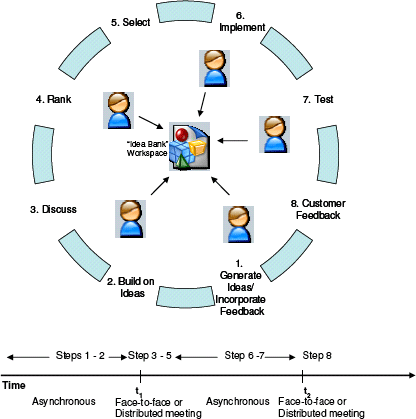
I was surprised when I first read this article stating that virtual brainstorming teams were more successful then "real" world brainstorming teams. I didn't want to believe it so I looked at some more articles. It seemed all the articles agreed with the first article. Until I read this article that presented some good points as to why a virtual team could be more beneficial then in real life. The article presented these ten rules that should be followed to create a working virtual brainstorming team.

  1. Invest in an online resource where members can learn quickly about one another.
  2. Choose a few team members who already know each other.
  3. Identify "boundary spanners" and ensure that they make up at least 15% of the team.
  4. Cultivate boundary spanners as a regular part of company wide practices and processes.
  5. Break the team's work up into modules so that progress in one location is not overly dependent on progress in another.
  6. Create an online site where a team can collaborate, exchange ideas and inspire one another.
  7. Encourage frequent communication. But don't try to force social gatherings.
  8. Assign only tasks that are challenging and interesting.
  9. Ensure the task is meaningful to the team and the company.
  10. When building a virtual team, solicit volunteers as much as possible.

I guess the world is changing and it looks like brainstorming teams are too. I hope it is as beneficial as the research shows. I still believe there is something to be said for "real" world interactions and brainstorming. I have always been more creative with people around then by myself, but maybe I'm an exception. Anyone else feel this way?

Picture from maxwideman.com

Monday, March 3, 2008

The Perfect Job & How You Get It

After being a part of hosting the PRSSA Regional Activity at AU this past weekend, I found this week's assigned reading very interesting. It tied into what PRSSA and most professionals try to stress: NETWORK!

It's quite simple yet most of the time it is overlooked by students and professionals. The best resource into learning how to network can be found here. The article by Priscilla March is a step-by-step guide to succeed in networking. I wish I had read this before the weekend, but luckily some of the information I already knew.

Another point to add is students or professionals should have business cards. It may sound overrated but I spoke to some professionals who said it makes the student stand out. If you stand out, then you are one step ahead of your competition.

Looking for work in D.C. is definitely competitive so getting an edge can definitely help the odds of getting employed. This would be where networking comes in as a very big component of getting an edge on the competition.


Knowing someone inside a company or knowing the right people can sometimes land you a job you didn't even know existed. I received my previous internship through attending a party. I happened to comment on how I was looking for an internship at the party. I came to find out that the gentleman hosting the party worked at a firm thatwas looking for a new intern. Next thing you know, I was interning at the firm and getting paid.

Eventually, I needed to spread my wings a bit and move on. Therefore, I am back to hoping for another opportunity to reveal itself. The best way to have that happen is to continue networking wherever I go. If it works, then I will be living the high life.

If it doesn't, then at least I will have met some new people and maybe expanded my amount of connections on LinkedIn!


With all that being said, anyone know someone who wants to hire me?

Monday, February 25, 2008

Google Me, I Dare You!


While reading different article about "You are What Your search result returns" and "When the Patient Is a Googler" made me think about how I have googled people and myself. As A Googler myself, I tend to Google people I don't know or people I'm interested in dating. I have come to find a lot of information by doing this. The Googled individuals seem to always be surprised at the information I find about them. It's simple yet some people seem to be unaware of the power of Google or search engines in general.
Here's a good example of what people are unaware of that Google can do. I was looking to purchase a temporary cell phone because I had recently had my AT&T phone stolen. I looked on craigslist and found a good deal and wanted to purchase the phone from the seller the next day. After e-mailing him, he responded very quickly. When trying to arrange a time to meet he became delayed in responding. I needed a phone as soon as possible and was getting impatient. I googled his name and his respective area that he mentioned he lived in. I found his name under a graduate from a local middle school. It appeared he was in his 40's and I thought this was the guy. That didn't help me to get him to respond any sooner.
I googled his e-mail address and found his AIM screen name on a paintball forum. This may seem creepy but I was desperate to get this phone! I IMed him which freaked him out a bit, but it got him to set up a time to met and make the transaction. I waited for him at the assigned location, and out jumped a 16 yr old punk (dressed like a wanna be gangster with a pimply face). I found my assumption to be wrong, but at least my googling got me my phone. I left him with this advice. If you don't want people finding you then make your contact information private.

After that occurrence it was nice to know some teens use their brains, as I discovered reading a Pew Report on Teen, Privacy and Online Social Networks that said:
Some 55% of online teens have profiles and most of them restrict access to their
profile in some way. Of those with profiles, 66% say their profile is not
visible to all Internet users. Of those whose profile can be accessed by anyone
online, nearly half (46%) say they give at least some false information. Teens
post fake information to protect themselves and also to be playful or silly.
Let's hope more teens follow these guidelines because privacy is really important if you want to stay safe in this Internet age.
Last thing, I am proud to say I have googled my name and nothing has lead back to the real me . . . yet.

Wednesday, January 16, 2008

BEGINNING TECHNOLOGY EDUMACATION

The world of blogging has now entered the world of education! I am an undergraduate student at American University. I plan to graduate soon and enter the real world. or should I say Reality 2.0.

I am writing this blog for my Social Networking & Business course in which I will use what I learn to take over the world. Just kidding, I'm not a terrorist.

In this post I must state the academic integrity code that EVERY school has created: On my honor, all posts on this blog are my own.